No hay resultados de contenido que coincidan con tu búsqueda.
Contenido

Ha finalizado sesión correctamente


¿No está registrado aún?
Detener la formación de úlceras por presión
Todos queremos evitar las úlceras por presión. En los últimos años se han logrado avances considerables en esta área. Sin embargo, las úlceras por presión siguen siendo un reto. B. Braun ofrece diferentes soluciones, incluidos productos para el cuidado y la protección de la piel. Tomar medidas desde el principio puede ayudarle a proteger a sus pacientes de las úlceras por presión. [1]
La información contenida en este sitio web está destinada exclusivamente a profesionales sanitarios. Absténgase de acceder si no es un profesional sanitario. Si es usted paciente, es importante que consulte a su médico.
Al aceptar, confirma que usted es profesional sanitario.

Las úlceras por presión pueden producirse si el riego sanguíneo de la piel o de los tejidos subyacentes se ve afectado. Los factores predisponentes incluyen limitaciones en la actividad/movilidad, deficiencias en la nutrición y la humedad de la piel, perfusión inadecuada y el uso de dispositivos mecánicos que ejercen presión sobre la piel. [2]
Las úlceras por presión pueden desarrollarse rápidamente, entre la primera hora y 4-6 horas después de una carga sostenida. [3]
Hasta
0%
de las úlceras por presión adquiridas en hospitales son evitables. [1]
En la mayoría de los casos, las úlceras por presión tienen un impacto significativo en la morbilidad del paciente [4] y la calidad de vida [5], e incluso pueden afectar a la supervivencia del paciente. [2]
El coste del tratamiento de las úlceras por presión puede ser más de 2,5 veces superior al de la prevención. [6]
Una guía de práctica clínica aceptada internacionalmente ofrece orientación sobre la prevención y el tratamiento de las lesiones por presión. [7] Recomenda un enfoque holístico que integre la nutrición adaptada, [8] el control de las comorbilidades [9], la hidratación [8] y la gestión de la humedad de la piel [10], entre otros.

Por ejemplo, cada vez que un paciente entra en una unidad de cuidados intensivos, se debe realizar una evaluación del riesgo de úlceras por presión, seguida de una evaluación periódica de la piel para comprobar cualquier signo de úlceras. Además, la nutrición desempeña un papel importante en el estado de salud general del paciente, lo que influye en la probabilidad de desarrollar lesiones por presión. Es importante evaluar las necesidades nutricionales y adaptar la dieta en consecuencia y garantizar una hidratación adecuada.

Soluciones
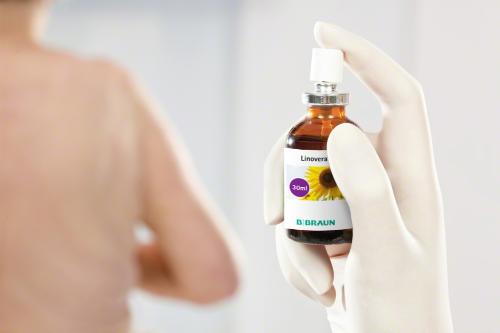
Ofrecemos una combinación de nuestras gamas de apósitos suaves y similares a cojines Askina® DresSil y Askina® Foam diseñados para ayudar a aliviar la presión y evitar la fricción, con productos adecuados para el control local de la humedad e hidratación de la piel, como Askina® Barrier y Linovera®.
Linovera® está indicado para la prevención y el tratamiento de úlceras por presión en estadio 1. Linovera® Emulsion está indicado para la prevención y el tratamiento de úlceras de extremidades inferiores, úlceras del pie diabético y úlceras por presión en estadio 1.
La formulación de los productos se basa en ácidos grasos hiperoxigenados, importante el ácido linoleico que pueden contribuir a una estructura cutánea sana. Otros ingredientes son el aloe vera y el gingko biloba (incluidos solo en la emulsión Linovera® ), que actúan como emolientes y humectantes. Centella Asiatica es un tónico calmante para la piel.
Linovera® lubrica la piel, reduciendo así el cizallamiento y la fricción y manteniendo la función de barrera de humedad de la piel.

Los productos de protección cutánea se utilizan para ayudar a reducir el riesgo de humedad excesiva relacionada con traumatismos. Es esencial evitar la sobreexposición de la piel a la humedad e implementar estrategias de prevención centradas en mantener la integridad de la piel. [10,13]
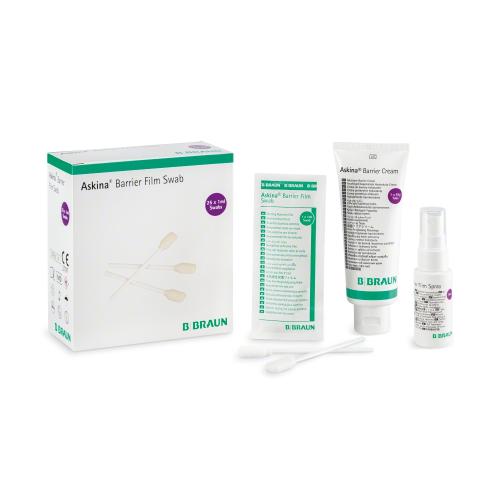
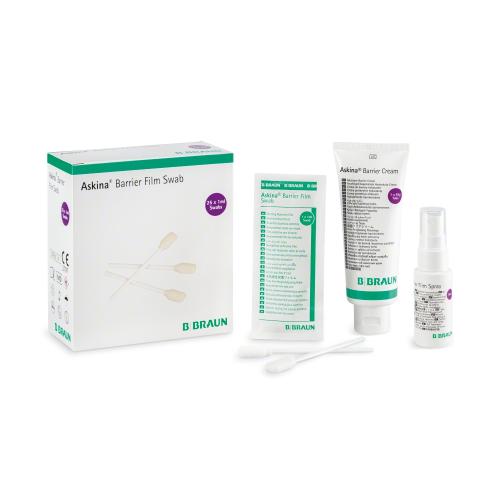
Askina® Barrier protege la piel de los fluidos corporales y proporciona una barrera duradera a la piel del paciente. Está disponible en tres formatos diferentes: Askina® Barrier Cream, Askina® Barrier Film Spray se puede aplicar sobre piel intacta o dañada y está especialmente indicado para proteger la piel perilesional.

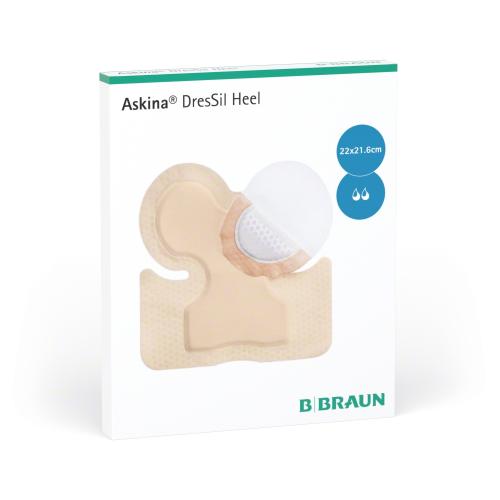
Las zonas como los talones o el sacro están especialmente expuestas continuamente a la presión y la fricción. Por lo tanto, necesitan más protección. Además de la aplicación de Askina® Barrier o Linovera® para el control de la humedad e hidratación, hay disponibles apósitos de espuma con forma anatómica para aliviar la presión.
Askina® Heel, Askina® DresSil Heel y Askina® DresSil Sacrum están fabricados para proteger los talones, los maléolos y el sacro.

Las prominencias óseas no son las únicas partes del cuerpo que pueden estar expuestas a presión y fricción. Pueden verse afectadas otras piezas, p. ej.: por dispositivos médicos que ejercen presión sobre la piel. [14]
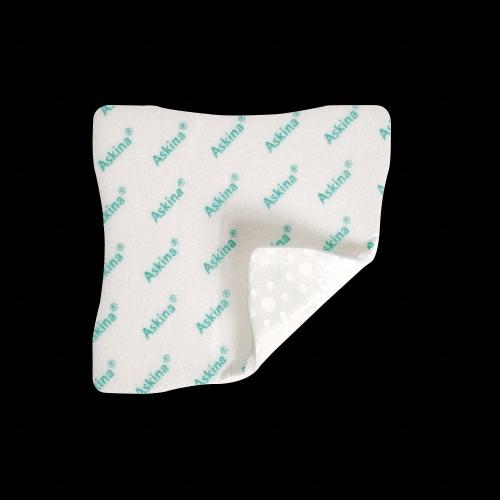
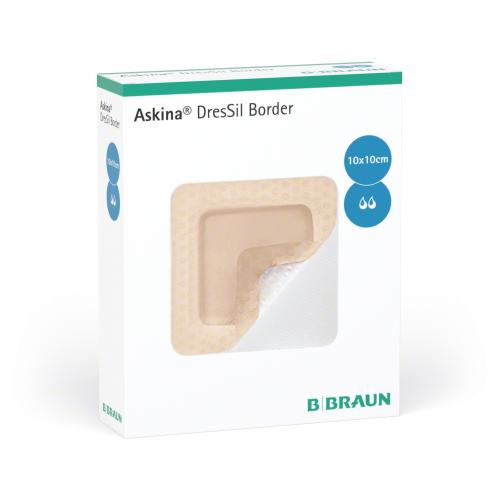
Askina® DresSil es una espuma con un adhesivo de silicona que proporciona una adhesión suave y segura y un traumatismo mínimo durante los cambios de apósito. Se puede cortar y dar forma para su aplicación en áreas más pequeñas que necesitan protección.
Askina® DresSil Borde es un apósito de espuma con adhesivo de silicona y un borde adhesivo adicional, diseñado para zonas difíciles de colocar o de mover (rodillas, codos, pliegues de la piel), ya que se adapta a una variedad de contornos anatómicos.
Cada apósito de espuma se puede volver a colocar durante la aplicación o incluso levantarse durante el tiempo de uso para comprobar la piel o la herida. También se pueden aplicar en heridas, ya que proporcionan un entorno húmedo que promueve la cicatrización natural.

Es la historia de Miguel Jopia Cuevas, un padre de familia chileno de 60 años que había contraído la COVID-19. Después de pasar 39 días en el hospital, recibió el alta con una úlcera por presión lumbosacra grave.
En el vídeo, revela el enorme impacto de la úlcera por presión en todos los aspectos de su vida: emociones, familia y profesión.
Aprenderá sobre su sufrimiento y las consecuencias, por no mencionar los altos costes asociados al tratamiento posterior de la úlcera por presión en estadio 3 por parte de una enfermera de atención domiciliaria.

Tratamiento de úlceras por presión
Una vez que se ha desarrollado una úlcera por presión, es importante elaborar rápidamente un plan de atención coordinado para promover la curación. [15,16] Obtenga más información sobre cómo el enfermero de Miguel consiguió curar su úlcera por presión.
Más información sobre el tratamiento de las úlceras por presiónPara obtener más información sobre el producto, consulte también las Instrucciones de uso (IDU) actuales.
[1] Chaboyer W, Bucknall T, Webster J, McInnes E, Gillespie BM, Banks M, Whitty JA, Thalib L, Roberts S, Tallott M, Cullum N, Wallis M. El efecto de una intervención centrada en el paciente sobre la incidencia de úlceras por presión (INTACT): Ensayo aleatorizado en grupo. Estudio Int J Nurs. 2016 Dic;64:63-71. doi: 10,1016/j.ijnurstu.2016.09:15. Epub 23 de septiembre de 2016.
[2] Labeau SO, Afonso E, Benbenishty J, Blackwood B, Boulanger C, Brett SJ, Calvino-Gunther S, Chaboyer W, Coyer F, Deschepper M, François G, Honore PM, Jankovic R, Khanna AK, Llaurado-Serra M, Lin F, Rose L, Rubulotta F, Saager L, Williams G, Blot SI; Equipo de estudio de DecubICUs; Colaboradores del grupo de ensayos de la Sociedad Europea de Medicina Intensiva (ESICM). Prevalencia, factores asociados y resultados de las lesiones por presión en pacientes adultos de la unidad de cuidados intensivos: el estudio DecubICUs. Cuidados intensivos 2021 Feb;47(2):160-169. doi: 10,1007/s00134-020-06234-9 Publicado el 9 de octubre de 2020. Error en: Cuidados intensivos Abril de 2021;47(4):503-520. PMID: 33034686; PMCID: PMC7880913.
[3] Respuesta A. ¿Cuánto tiempo se tarda en desarrollar una úlcera por presión? Evidencia integrada de estudios en seres humanos, animales e in vitro. Tratamiento de heridas de ostomía. 2008 Oct;54(10):26-8, 30-5. PMID: 18927481.
[4] Graves N, Weinhold D, Tong E, Birrell F, Doidge S, Ramritu P, Halton K, Lairson D, Whitby M. Efecto de la infección adquirida en la asistencia sanitaria sobre la duración de la estancia hospitalaria y el coste. Control de infecciones hospital Epidemiol. 2007 Mar;28(3):280-92. doi: 10,1086/512642. Epub 20 de febrero de 2007 PMID: 17326018.
[5] Sebba Tosta de Souza DM, Veiga DF, Santos ID, Abla LE, Juliano Y, Ferreira LM. Calidad de vida relacionada con la salud en pacientes de edad avanzada con úlceras por presión en diferentes entornos de atención. J Enfermera de incontinencia de ostomía de heridas. 2015 Jul-Ago;42(4):352-9. doi: 10,1097/WON.0000000000000142. PMID: 26135820.
[6] Demarré L, Van Lancker A, Van Hecke A, Verhaeghe S, Grypdonck M, Lemey J, Annemans L, Beeckman D. El coste de la prevención y tratamiento de las úlceras por presión: Una revisión sistemática. Estudio Int J Nurs. 2015 Nov;52(11):1754-74. doi: 10,1016/j.ijnurstu.2015.06:06. Epub 25 de junio de 2015. PMID: 26231383.
[7] European Pressure Ulcer Advisory Panel, National Pressure Injury Advisory Panel y Pan Pacific Pressure Injury Alliance. Prevención y tratamiento de úlceras/lesiones por presión: Directrices de práctica clínica Directriz internacional. 3rd ed. Haesler E, ed. 2019. http://internationalguideline.com. Última consulta: 27 de diciembre de 2019.
[8] Munoz N, Posthauer ME, Cereda E, Schols JMGA, Haesler E. El papel de la nutrición en la prevención y curación de lesiones por presión: Las recomendaciones de las Directrices internacionales de práctica clínica de 2019. Cuidado avanzado de la piel. 2020 Mar;33(3):123-136. doi: 10,1097/01.ASW.0000653144,90739.ad. PMID: 32058438.
[9] Jaul E, Barron J, Rosenzweig JP y Menczel J. Una visión general de las comorbilidades y el desarrollo de las úlceras por presión en adultos mayores. BMC Geriatr. 11 de diciembre de 2018;18(1):305. doi: 10,1186/s12877-018-0997-7. PMID: 30537947; PMCID: PMC6290523.
[10] Yusuf S, Okuwa M, Shigeta Y, Dai M, Iuchi T, Rahman S, Usman A, Kasim S, Sugama J, Nakatani T, Sanada H. Microclima y desarrollo de úlceras por presión y cambios superficiales en la piel. Int Wound J. 2015 Feb;12(1):40-6. doi: 10,1111/iwj.12048. Epub 12 de marzo de 2013. PMID: 23490303; PMCID: PMC7950852
[11] Gerhardt LC, Strässle V, Lenz A, Spencer ND, Derler S. Influencia de la hidratación epidérmica en la fricción de la piel humana contra los textiles. Interfaz J R Soc. 2008 Nov 6;5(28):1317-28. doi: 10,1098/rsif.2008,0034. PMID: 18331977; PMCID: PMC2607440.
[12] Lavallée JF, Gray TA, Dumville J, Cullum N. Prevención de úlceras por presión en residencias de ancianos mediante el uso de un paquete de cuidados: Estudio de viabilidad. Comunidad de atención sanitaria. 2019 Jul;27(4):e417-e427. dos: 10,1111/hsc.12742. Epub 27 de marzo de 2019. PMID: 30919525; PMCID: PMC6618244.
[13] Voegeli D, Hillery S. Prevención y tratamiento del daño cutáneo asociado a la humedad. Br J Nurs. 12 de agosto de 2021;30(15):S40-S46. dos: 10,12968/bjon.2021.30:15.S40. PMID: 34379461.
[14] Barakat-Johnson M, Lai M, Wand T, Li M, White K, Coyer F. La incidencia y prevalencia de las úlceras por presión relacionadas con dispositivos médicos en cuidados intensivos: una revisión sistemática. J Cuidado de heridas. 2 de agosto de 2019;28(8):512-521. doi: 10,12968/jowc.2019.28.8:12. PMID: 31393800.
[15] Stolt M, Hjerppe A, Hietanen H, Puukka P, Haavisto E. Tratamiento local de las úlceras por presión en cuidados de larga duración: un estudio transversal correlacional. J Cuidado de heridas. 2 de junio de 2019;28(6):409-415. doi: 10,12968/jowc.2019.28.6:09. PMID: 31166863.
[16] Sibbald RG, Elliott JA, Persaud-Jaimangal R, Goodman L, Armstrong DG, Harley C, Coelho S, Xi N, Evans R, Mayer DO, Zhao X, Heil J, Kotru B, Delmore B, LeBlanc K, Ayello EA, Smart H, Tariq G, Alavi A, Somayaji R. Preparación del lecho de la herida 2021. Cuidado avanzado de la piel. 1 de abril de 2021; 34(4): 183-195. doi: 10,1097/01.ASW.0000733724,87630.d6.